From Runway Statement to Everyday Bag: Which Fashion Week Designs Are Commercially Relevant?
Fashion Week Trend Analysis | Spring/Summer 2027 & Fall/Winter 2026
Fashion Week is where designers challenge conventions, introduce new silhouettes, and redefine how accessories complement modern wardrobes. But for handbag brands, not every runway statement translates into a commercially successful product.
Some designs attract attention because of their dramatic proportions or unconventional construction. Others become more influential by introducing subtle changes to familiar shapes, materials, colors, and hardware. For brands planning their next handbag collection, the real opportunity lies in identifying which runway ideas can evolve into desirable, functional, and commercially viable products.
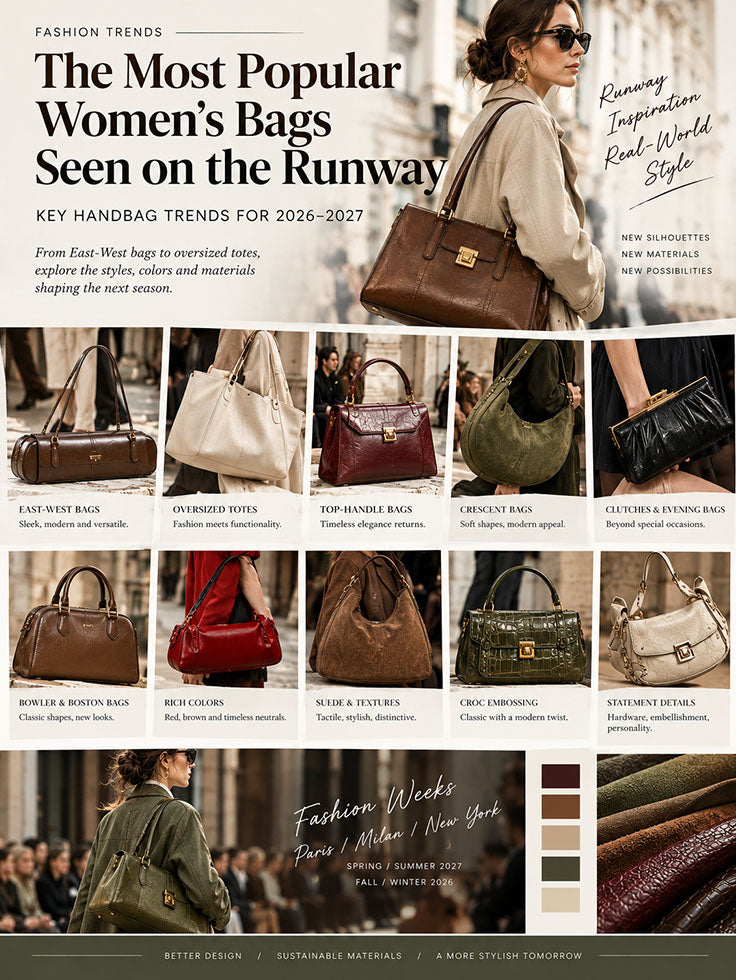
Recent Fall/Winter 2026 handbag coverage and the Spring/Summer 2027 fashion season reveal several useful directions for product development: elongated silhouettes, oversized everyday bags, refreshed heritage shapes, tactile finishes, and more expressive design details. These trends offer inspiration for brands seeking to balance fashion relevance with practical use and manufacturing feasibility. Vogue's Fall 2026 handbag trend report and Spring/Summer 2027 accessories coverage from Wallpaper* provide useful examples of these evolving design directions.
1. Why Runway Trends Don't Always Translate Into Commercial Success
Runway bags are designed to support a creative vision. Their purpose may be to communicate a collection's theme, introduce a new design language, or create a memorable fashion moment. Commercial handbags, however, must meet a wider range of expectations.
Consumers consider several factors before purchasing a bag:
-
Functionality: Does it accommodate everyday essentials and suit the intended occasion?
-
Versatility: Can it work with different outfits, settings, and seasons?
-
Design appeal: Does it look distinctive without becoming difficult to style?
-
Perceived quality: Do the materials, construction, hardware, and finishing justify the price?
-
Long-term relevance: Will the design remain appealing after the initial trend cycle?
For handbag brands, this means distinguishing between a trend that generates attention and a design direction that can support a repeatable product line.
A dramatic sculptural bag may work well as a campaign centerpiece or limited-edition release. Meanwhile, a familiar shoulder bag with a refreshed silhouette, premium texture, or distinctive closure may have broader appeal across retail channels.
The most commercially useful runway ideas often sit between these two extremes: recognizable enough to be accessible, but distinctive enough to give a collection a clear identity.
2. Five Fashion Week Handbag Trends With Commercial Potential
Trend 1: East-West Bags and Elongated Silhouettes
The east-west bag remains a prominent handbag direction in Fall/Winter 2026 trend coverage. Its elongated horizontal profile offers a modern alternative to traditional rectangular shoulder bags and compact top-handle styles. Vogue has highlighted the silhouette across several formats, including shoulder bags, totes, and top-handle designs.
Why it could work commercially
The shape has a recognizable fashion identity without requiring an entirely unfamiliar design. It can look polished with office clothing, relaxed with denim, and refined enough for evening occasions.
Its commercial potential depends on getting the proportions right. An extremely narrow bag may be visually striking but limit storage. A slightly wider gusset, carefully planned interior, and comfortable strap can make the silhouette more useful without losing its distinctive profile.
Product development opportunities
-
Slim east-west shoulder bags for everyday styling
-
Elongated top-handle bags for contemporary workwear
-
Medium-sized versions with adjustable or detachable straps
-
Minimal designs enhanced by distinctive hardware or textured materials
For manufacturers, the key considerations include opening width, zipper placement, strap attachment strength, and how the bag maintains its shape when filled.
Commercial outlook: Strong potential for brands looking for a trend-aware silhouette that can be adapted into multiple product tiers.
Trend 2: Oversized Shoulder Bags and Functional Volume
Fall/Winter 2026 runway coverage also points to renewed interest in oversized shoulder bags and generous carryall silhouettes. British Vogue identifies both oversized shoulder bags and crescent-shaped designs among the season's notable directions.
This trend reflects an opportunity to combine visual impact with practical capacity. Instead of treating a large bag as a purely functional accessory, designers are making volume itself part of the aesthetic.
Why it could work commercially
Consumers may need one bag to move between commuting, shopping, travel, and other daily activities. A spacious bag can address these needs while providing a relaxed, fashion-forward appearance.
However, bigger does not automatically mean better. Excessive weight, an uncomfortable strap, poor organization, or an opening that is difficult to access can undermine the product's appeal.
Product development opportunities
-
Soft oversized shoulder bags with flexible construction
-
Work totes with dedicated compartments for everyday essentials
-
Lightweight nylon carryalls with premium finishing
-
Structured large bags that retain their silhouette without feeling rigid
Brands should evaluate bag weight, strap drop, handle reinforcement, pocket placement, and the stability of the base. Load testing is particularly important when the design is intended to carry heavier items.
Commercial outlook: Promising for work, lifestyle, and travel-oriented collections, provided comfort and usability are designed into the product.
Trend 3: Heritage Shapes With a Modern Update
Classic handbag formats continue to provide a strong foundation for new collections. Fall/Winter 2026 coverage highlights renewed interest in top-handle bags, flap bags, and familiar silhouettes refreshed through updated proportions, colors, and finishes.
The Spring/Summer 2027 season also demonstrates how established design signatures can be revisited through new interpretations rather than replaced entirely. At Dior, for example, familiar bag families appeared alongside new variations and details during the Spring/Summer 2027 presentation, as reported by Vogue Arabia.
Why it could work commercially
A recognizable shape helps customers understand how a bag fits into their wardrobes. Updating the proportions or details can make the design feel current while reducing the need to educate consumers about an entirely unfamiliar product category.
This approach can also help brands build a consistent product identity over multiple seasons.
Product development opportunities
-
Modern top-handle bags with softened edges
-
Classic flap bags with updated closures
-
Bucket bags with cleaner proportions and improved organization
-
Heritage-inspired shoulder bags in contemporary colors and materials
Rather than copying a recognizable designer bag, brands can identify the broader design principle—such as a curved silhouette, a balanced top handle, or a distinctive flap—and develop an original interpretation.
Commercial outlook: Strong potential for brands seeking products that combine recognizable styling with longer-term collection continuity.
Trend 4: Texture and Surface Details That Elevate Simple Shapes
Another important direction is the use of texture to give familiar silhouettes greater visual impact. Croc-embossed finishes, woven surfaces, tactile materials, and decorative construction details have all appeared in recent handbag trend coverage.
The appeal of this approach is that the bag's overall shape can remain relatively simple while its surface creates a more distinctive impression.
Why it could work commercially
Texture can increase perceived design value without requiring an unusually complex silhouette. It also creates opportunities to differentiate products across price points through material selection, surface treatment, and finishing quality.
For example, a structured tote can look very different in smooth microfiber, embossed vegan leather, woven material, or a softly grained surface.
Product development opportunities
-
Croc-embossed or other textured finishes on classic shapes
-
Woven panels combined with simpler structural elements
-
Soft-grain materials for relaxed shoulder bags
-
Tonal stitching and carefully selected hardware for understated luxury
Material samples should be evaluated for appearance, flexibility, abrasion resistance, color consistency, and ease of maintenance. Embossed or woven surfaces also require particular attention to seam placement and finishing.
Commercial outlook: Strong potential for brands that want to refresh core styles without changing the entire silhouette.
Trend 5: Statement Details and Personalization
The Spring/Summer 2027 fashion season has also featured more experimental accessory ideas. Wallpaper* highlighted inside-out handbags at Jil Sander and customizable scarf bags at Dior, illustrating how construction and personalization can become part of a design's visual identity.
Not every experimental detail is suitable for mass-market production. Nevertheless, these ideas point toward a broader opportunity: consumers can recognize a bag through the way it is constructed, customized, or styled—not just through its logo.
Why it could work commercially
Distinctive details can make a product easier to recognize in crowded markets. Personalization can also create opportunities for gifting, limited editions, seasonal collections, and private-label differentiation.
Product development opportunities
-
Customizable straps, charms, or detachable accessories
-
Distinctive zipper pulls and original hardware shapes
-
Contrast lining or carefully designed interior details
-
Personalized color combinations and branded components
-
Convertible bags with adjustable carrying options
The most effective approach is selective rather than excessive. One memorable detail may create a stronger product identity than several unrelated decorative elements.
Commercial outlook: Particularly useful for brands developing signature products, gifting collections, or differentiated private-label ranges.
3. How to Evaluate Whether a Runway Design Is Commercially Relevant
A runway appearance is a useful trend signal, but it is not proof of retail demand. Brands should assess each idea against their target customers, price positioning, and manufacturing capabilities before committing to a full collection.
The following framework can help turn inspiration into a more structured product decision.
| Evaluation factor | Key question | What to look for |
|---|---|---|
| Customer relevance | Does the design suit the target customer? | Clear use case and appropriate styling |
| Everyday functionality | Can it accommodate realistic daily needs? | Suitable capacity, access, comfort, and organization |
| Design differentiation | Does it stand out from competing products? | A recognizable silhouette, texture, or signature detail |
| Cost and price positioning | Can it achieve the intended retail price and margin? | Feasible materials, components, labor, and production cost |
| Manufacturing feasibility | Can the design be produced consistently at scale? | Reliable construction methods and manageable quality risks |
| Collection potential | Can the idea support more than one SKU? | Opportunities for size, color, material, or feature variations |
A useful strategy is to separate product ideas into three groups:
Core commercial products: Familiar, versatile styles designed to serve ongoing customer needs.
Trend-led products: Updated silhouettes, colors, materials, or hardware that give a collection seasonal relevance.
Statement products: More experimental designs intended to attract attention, strengthen brand identity, or support a limited release.
This balance allows brands to explore creative ideas without making the entire collection dependent on unproven trends.
4. From Runway Inspiration to a Manufacturable Handbag
A commercially promising idea still needs to be translated into a product that can be sampled, costed, tested, and manufactured consistently.
This is where collaboration between design, sourcing, and manufacturing teams becomes especially important.
Step 1: Define the Product's Purpose
Start with the intended customer and use case. Is the bag designed for commuting, everyday styling, travel, gifting, or special occasions?
The answer will influence the ideal size, material, carrying options, interior structure, and price range.
Step 2: Translate the Trend Into Specific Design Features
Instead of using a broad instruction such as “make it look like the runway trend,” identify the actual elements to develop.
For example, an east-west bag project might specify:
-
An elongated horizontal silhouette
-
A medium-capacity interior
-
A comfortable shoulder strap
-
A secure zipper or magnetic closure
-
A clean exterior with one distinctive hardware element
This creates a more actionable product brief and gives the design and manufacturing teams clearer criteria for evaluating samples.
Step 3: Assess Materials and Construction
The selected material affects not only the bag's appearance but also its weight, flexibility, structure, cost, and durability.
Soft silhouettes may require different reinforcement from structured top-handle bags. Textured materials may affect seam placement, edge finishing, or pattern alignment. Statement hardware can introduce additional weight or assembly requirements.
These considerations should be reviewed early, before the design becomes too expensive or difficult to revise.
Step 4: Develop and Test a Prototype
A prototype helps the team evaluate proportions, capacity, comfort, construction, and visual quality.
For trend-driven designs, it is particularly important to check whether the product looks as intended when carried—not just when photographed or displayed empty.
Depending on the product, testing may include strap strength, zipper performance, hardware attachment, seam durability, material wear, and color consistency.
Step 5: Prepare for Consistent Production
Before moving into bulk production, brands and manufacturers should align on approved materials, specifications, construction methods, workmanship standards, and quality-control requirements.
A design that works in a single sample may still require refinement to achieve consistent results across a larger order.
Early collaboration helps identify potential production issues, control unnecessary development costs, and reduce avoidable revisions.
5. What This Means for Handbag Brands Planning Their Next Collection
For brands preparing future collections, the most useful Fashion Week trends are not necessarily the most dramatic ones. The stronger opportunities often come from combining a recognizable product format with a carefully chosen update.
A brand might develop a classic shoulder bag using a more elongated silhouette, introduce a woven surface on an established tote shape, or create a top-handle bag with distinctive hardware and improved everyday organization.
The aim is to create a product that feels relevant now while remaining useful beyond a single fashion moment.
Brands should also consider how one design direction can be developed into a coherent range. A successful concept might extend across multiple sizes, materials, colors, or carrying options, allowing the collection to serve different customers without losing its identity.
For B2B buyers and product development teams, this is an opportunity to collaborate with manufacturers early in the process. Design feasibility, material sourcing, sampling, target costing, and quality requirements should be considered together—not treated as separate steps after the creative direction has already been finalized.

6. How OEM/ODM Manufacturing Supports Trend-Driven Product Development
For brands working with an OEM/ODM bag manufacturer, runway-inspired development can involve more than reproducing a reference image. It requires turning a creative direction into a product that aligns with brand positioning, customer expectations, cost targets, and production requirements.
An experienced manufacturing partner can support the process through:
-
Design development: Refining silhouettes, proportions, functional details, and product specifications.
-
Material selection: Evaluating suitable fabrics, synthetic leather, hardware, linings, and other components.
-
Sampling and prototyping: Assessing construction feasibility and refining the design before production.
-
Private-label customization: Developing brand-specific colors, components, labels, packaging, and product details.
-
Production planning and quality control: Establishing specifications and inspection criteria for consistent bulk manufacturing.
For brands seeking differentiation, the objective is not simply to follow a trend. It is to interpret that trend in a way that supports the brand's own design language and commercial strategy.
At Journion, we work with brands on bag development and manufacturing, including OEM/ODM and private-label projects. Early communication about the target market, intended retail positioning, materials, and product requirements can help establish a clearer path from initial concept to finished product.
Conclusion: The Best Runway Trends Are the Ones Brands Can Make Their Own
Fashion Week provides a valuable preview of the silhouettes, textures, and design details that may influence future handbag collections. Fall/Winter 2026 highlights the continuing appeal of elongated bags, oversized shoulder styles, heritage shapes, and tactile finishes, while Spring/Summer 2027 introduces more experimental approaches to construction and personalization.
For handbag brands, the opportunity lies in identifying the elements that match their customers and adapting them with purpose. A trend becomes commercially relevant when it combines visual appeal with functionality, an appropriate price position, distinctive brand identity, and reliable manufacturing feasibility.
By evaluating runway inspiration through both a design and business lens, brands can develop collections that feel current without relying entirely on short-lived fashion moments.
Planning a new handbag collection? Journion supports OEM/ODM and private-label bag development, helping brands explore materials, refine designs, and move from product concepts toward manufacturable solutions.